


Artificial Intelligence, or AI, is “the application of computer systems able to perform tasks or produce output normally requiring human intelligence, especially by applying machine learning techniques to large connections of data.” It was officially introduced in 1956 when the term was coined at the Dartmouth Conference.
Since then, it has become more and more advanced, especially in recent years. It can be seen everywhere around the world. There are a multitude of positives that come with these advancements, however that is not all we should be looking at.
AI has been used to enhance healthcare all over the world. It can be used to help speed up the diagnosis process and improve personalized treatment plans. It has helped detect medical mysteries and saved lives everywhere. For example, at the University of Texas MD Anderson Cancer Center, researchers have been using AI to detect pancreatic cancer by developing algorithms that analyze MRIs and other medical images to flag down potential tumors and other life threatening injuries. At Stanford Health Care and Stanford Medicine use AI to identify and assess patients at risk of various conditions.
Not only has AI changed the world of health care, it has changed the way that humans do things in agriculture. According to the Future Farmers of America New Horizons, the official magazine of the National Farmers of American Organization, AI has helped improve productivity in the farming industry. By using algorithms created by artificial intelligence, farmers can be advised about what crops to plant, when to plant them along with a multitude of other recommendations. It can also help farmers to practice sustainable agriculture by helping them use their resources with precision.
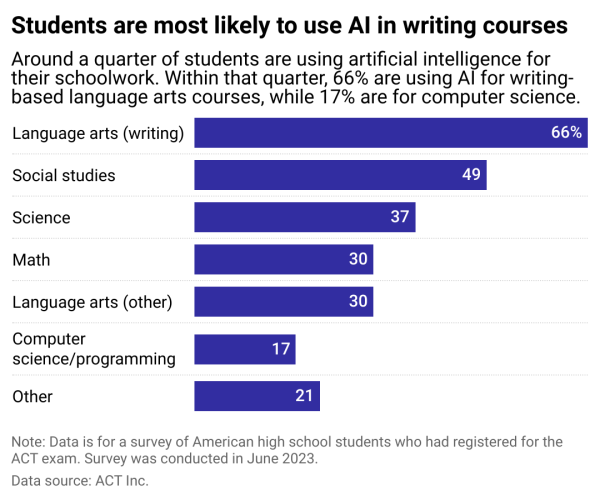
There is a world that AI has also been used in, more over the past few years: the academic world. Many students have used AI to receive instant feedback on assignments and tutoring. This is how AI should be used in the classroom. It shouldn’t be used to do assignments for students, however it is.
According to a survey conducted by the Digital Education Council, 86% of students use AI in their studies, with 54% using it weekly and one in four using it daily. While there isn’t evidence or a survey calculating the amount of students that use artificial intelligence to complete the entirety of their school work, I have seen it first hand. I watched with my own two eyes as a kid in my study hall last year, typed a question in ChatGPT, copied the AI generated text and pasted it into a Google Classroom assignment.
Many AI services claim to have policies and safeguards designed to prevent students from using their service to cheat, however they aren’t effective, given what I have seen. Multiple other students and even teachers have also seen this.
No matter how much these artificial intelligence services claim that they have measures in place to prevent students from abusing their systems, they aren’t working. They never are. Students are always going to use AI, some use it the right way and some use it in the wrong way.
This is the world that we live in now, the world of AI. Students are now always going to have access to artificial intelligence systems and students are now always going to use it for their school assignments. I’m not saying that this is an awful thing. Artificial intelligence can be extremely beneficial to students. I have used it, multiple times, to help me with school. Whether it was helping me solve some math or physics problems during my junior year or entering my college essay to help me get rid of unnecessary words or phrases. That is the way it should be. AI being used to complete whole assignments takes away from the learning process.
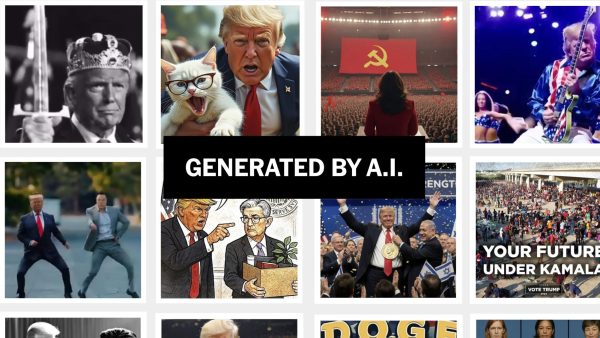
AI has also been used increasingly more in the world of politics, particularly as a political weapon. Many political leaders have created AI generated images that target people that oppose them. For example, President Donald Trump has posted approximately 60 images or videos across multiple social media platforms doing this very thing. According to the New York Times article titled, “How Trump Is Using Fake Imagery to Attack Enemies and Rouse Supporters,” Trump has posted 14 AI generated images and videos attacking his political opponents, 19 boosting his 2024 presidential campaign, seven about his policies and administration, with another 21 being about himself.
The number will, without a doubt, increase over the course of his term. As much as I would love to rant about how useless all of those posts are, how they continue to spread hate and how there are much better things that the president could be spending his time doing; Donald Trump isn’t the only world leader to use artificial intelligence as a form of propaganda. Javier Milei, the president of Argentina used AI heavily to attack his opponent, Sergio Massa, and to promote himself during the 2023 Argentine presidential campaign. There are so many others.
Having artificial intelligence being used in such a way is dangerous and terrible. There is so much potential for misuse and harm. AI can be used to create highly realistic deepfakes, like fake images, audio and videos, and show a person saying or doing something that they never did which can lead to a continuous spread distrust and of hatred. There is no reason to put more of that into our world today.
Also, why is a powerful world leader so focused on making AI generated videos of flying a jet, wearing a crown or dumping poop on peaceful protesters? Instead maybe have AI create a video or image that might somehow help the 673 million people that went hungry over the past year? Why aren’t we focused on doing more good than harm?
There is another problem that AI is contributing to, but it has nothing to do with propaganda or fake images.
Climate change is a real issue and it is getting worse. The increase of AI usage isn’t helping. This is a paragraph from an article published by the United Nations Environmental Programme, a global authority on the environment that coordinates environmental efforts within the United Nations’ jurisdiction. It is titled, “A.I. has an environmental problem. Here’s what the world can do.”
“Most large-scale A.I. deployments are housed in data centers, including those operated by cloud service providers. These data centers can take a heavy toll on the planet. The electronics they house rely on a staggering amount of grist: making a 2kg computer require 800 kg of raw materials. As well, the microchips that power A.I. need rare elements, which are often mined in environmentally destructive ways, noted Navigating New Horizons. The second problem is that data centers produce electronic waste, which often contains hazardous substances, like mercury and lead. Third, data centers use water during construction and, once operational, to cool electrical components. Globally, A.I.-related infrastructure may soon consume six times more water than Denmark, a country of 6 million, according to one estimate. That is a problem when a quarter of humanity already lacks access to clean water and sanitation. Finally, to power their complex electronics, data centers that host A.I. technology needs a lot of energy, which in most places still comes from burning of fossil fuels, producing planet-warming greenhouse gases. A request made through ChatGPT, an A.I.-based virtual assistant, consumes 10 times the electricity of a Google Search, reported the International Energy Agency. While global data is sparse, the agency estimates that in the tech hub of Ireland, the rise of A.I. could see data centers account for nearly 35% of the country’s energy use by 2026. Driven in part by the explosion of A.I., the number of data centers has surged to 8 million for 500,000 in 2021, and experts expect the technology’s demands on the planet to keep growing.”
I know that some people couldn’t be bothered to read all of that entire quote, so I’ll just put it into bullet points.
- To make a computer (2 kg) for the use of AI, there will be a sacrifice of 800 kg of raw materials
- AI produces hazardous wastes, like mercury and lead. Both of these substances are highly toxic and deadly to not just humans, but to the planet as a whole.
- AI, globally, consumes more water than the entire country of Denmark. Not just two times more, but SIX times more. Denmark is the home of 6 million people, mind you.
- ChatGPT uses 10 times more electricity than Google Search.
- AI will account for 35% of Ireland’s energy consumption by 2026.
- There are now more than 8 million data centers for AI. That number was 500,000 in 2012.
This isn’t all. AI will much more harm to our planet. According to Reuters, because of the use of artificial intelligence, Amazon, Microsoft, Meta and other large corporations drastically increased their indirect emissions into the atmosphere. Amazon’s carbon emission grew 182% from 2020 to 2023, with Microsoft growing by 155% and Meta by 145%, all because of the operations of those companies that are being overseen by AI.
Why are people so excited about the advancements of artificial intelligence if it is doing so much harm? Yes, it is helping solve medical mysteries and helping farmers produce their products the most efficiently. However, look at everything else it is doing. Global warming is already increasing to high, without the use of AI. Why add more fuel to that fire?
Many argue that climate change isn’t happening. Look at the world around you. It isn’t normal that the oceans are rising 0.14 inches every year. It isn’t normal to have so many wildfires every year. According the National Interagency Fire Center, in the year 2024, there were 64,897 fires that burned around 8,924,884 acres of land around the world. It isn’t normal that natural disasters are getting more intense and deadly. Climate change is real and AI is not going to help.
I’m not saying that we should get rid of artificial intelligence entirely, I think that it can be very useful. We can see the amazing results it has done in health care and agriculture just to name a few. However, AI should not be misused. It should not be used to cheat in school. You’re not learning anything. If people continue to use artificial intelligence throughout high school, it is going to become a habit, something that you are going to continue to use regularly and eventually you won’t be able to think or problem solve on your own.
AI into the political world, really? We have really reached a point in our society where political leaders feel the need to create AI generated images to try and make themselves look better. It does not make you look better. As a matter of fact, it makes you look foolish. Do other countries, leaders, even your own citizens look at that and immediately think of you as mature and responsible? Trust me, they don’t. When I see an AI generated image, involving anything, not just politics, I either roll my eyes or burst out laughing because it looks so ridiculous.
The effects that AI has on climate change are also ridiculous. Why are we in full support of companies that openly don’t care about the environment, who know that what it takes to operate their services in extremely harmful?
I am in full support of using AI as a way to help society, but I think that there should be some changes. There should be regulations on the amount of natural resources that AI companies can use and how much gases they emit into our atmosphere. There should also be regulations on students using AI assignments in schools as it is only going to create more problems when students become adults and learn that they don’t know how to learn or problem solve without asking AI. As for AI in politics, politicians could be doing much better things in our society instead of creating AI propaganda.
There should be more things being done about artificial intelligence to help increase the positives and lower the negatives.


