


Bed ridden with rheumatic fever and surrounded by the busyness of the city, a young Nevin Robinson became captivated by the beauty Pittsburgh had to offer. With nowhere to go due to his illness, and looking for a way to fill his time, Robinson began teaching himself how to draw from photo reference.
There was never a lack of subjects; any and all newspaper or magazine clippings he could get his hands on were a learning tool. His skill rapidly developed and changed the course of his life forever as his drawings quickly became beloved by Pittsburghers.
The first time Robinson ever drew a Pittsburgh scene was when he was 12 years old for an art contest for the Smithsonian Institute. Out of the 10,000 entries people sent into the competition, only 100 were selected, and one of them was his.
“They had a competition for us to submit a Pittsburgh scene. While we were doing it in school, my friend threw a paintbrush across the room and it landed on my drawing. It made a blue splotch in the middle. I turned it into a lake. I submitted the painting, and actually won the award. They shifted around the country showing people the artwork. So it was good for me; it wasn’t money, but I beat 10,000 entries. They picked 100, and I was one of the 100,” said Robinson.
His passion for creating began in his early years, when he spent a lot of his time entering art contests and developing his skill. He attended weekly art lessons at the Carnegie Museum of Art and following his graduation from Schenley High School, he began exploring the possibility of creating art professionally.
“I think about it as this — I had the chance of art. I tried right out of high school. I took my portfolio into the Mellon Foundation because I knew they’d give away grants. I went in, and the guy said, ‘Come back once you go to art school.’ So I did; I went to art school. It was real professional looking, and there was one moment that I really thought about being an artist,” he said. “The people that worked there, all the artists, took me under their wing. Every couple of months, I’d go back and visit and see what they’re doing, and they’d give me one of the drawings as a sample. Then, I got to assist a guy named Richard Welling for an American Artist magazine, and I got inspired by his drawings.”
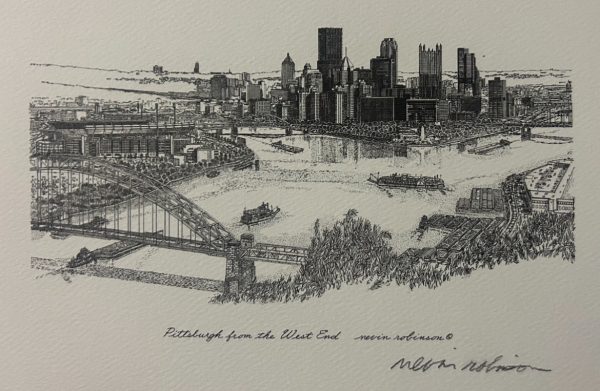
Robinson spent his time taking lessons at numerous downtown art schools until graduating from The Art Institute of Pittsburgh in 1971. He then went on to explore the artistic cultures of Europe, as artistic techniques vary drastically across the world. Traveling between Germany, Switzerland and Italy, he experienced a variety of environments, and found it to be a rewarding educational tool.
“It was just so different from Pittsburgh, a lot of excitement. It really inspired me to go further. You draw better because you just go every day and you spend the time on that. Whereas if you try to teach yourself, it just takes so long, you teach yourself the wrong way, maybe the wrong tools,” Robinson said.
In the early 70s, Robinson had been scrambling to sell prints of his drawings anywhere he could. While selling prints in his booth at the now closed Horne’s Department store on Stanwix Street, a woman by the name of Kathleen caught his attention.
The two have been married for over 47 years and have two children. While working as a delineation artist for architects in Beaver County, Robinson would sell his prints at any and all local art shows he could. Mrs. Robinson helped with the management of his art booth; from handling the sales to aiding in the mat and framing process.
“The 1973 Three Rivers Arts Festival. I drew a city scene and made prints of them. I could not sell them fast enough. I was selling them for around three dollars each, and rolling them up. Once you get a taste of people fighting over your drawings… that’s what started me off,” he said.
When their oldest, Lauren, was just four months old, Mr. Robinson had been laid off from his job as a delineation artist. It was during this time that he and his wife made the ultimate decision of opening a year-round booth at Station Square, a decision that transformed his craft into a career.
His audience became very diverse, and everyone wanted a piece of Nevin Robinson’s art. Aside from prints, he also created a large portion of commissions. Commissions were unique art pieces that people specifically ordered. All commissions were originals, and the client would choose the size and subject. Companies would reach out to him and order specific pieces, such as Eat’n Park and local film companies.
“Love and Other Drugs was one movie that had his art. When they were pretending the movie was shot in Pittsburgh, they put Pittsburgh scenes on the wall, and they had a production company upstairs at Station Square. They would come down and buy the things. We did actually see them in a couple movies. The most recent one was a TV show, American Rust, and it’s still on. They bought a whole pile of his things,” Mrs. Robinson said.
Once the demand for his work was established, Robinson’s name quickly spread around the city. His work was recognizable due to his consistent subject matter and style. The achromatic color scheme, paired with the timeless and complex style, allowed his drawings to fit in every environment.
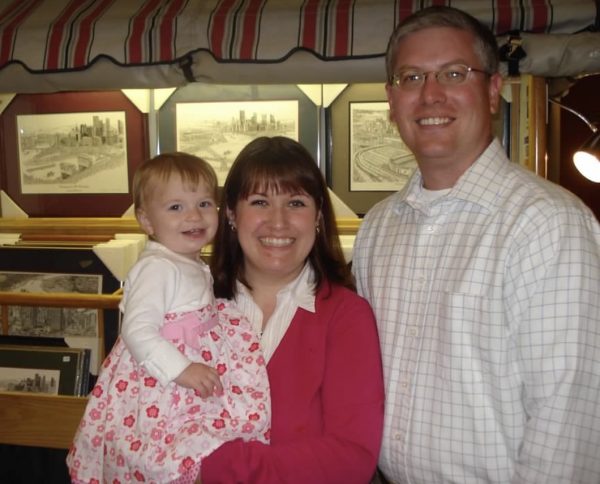
“The key to getting your name out there is to get copies of your work out there, which are inexpensive reproductions that people can afford. Another thing that I think was the key to his success is working in pen and ink. Lots of artists are afraid of it because you don’t get a second chance. And believe me, there were lots of times when he threw his pen across the room, or his Rapidograph pen would drip ink. Ink is a hard, hard medium and not many people work in it, but it’s great for print making,” said Mrs. Robinson.
Very few artists, in modern times, are fortunate enough to make a livable wage solely from their art. Most fall into specific fields, such as teaching, graphic design, or architecture; but to be entirely self employed, and supporting a family of four off of your art – that’s something special.
After 38 years in Station Square — the longest any business had stayed in that space— Mr. and Mrs. Robinson packed their booth up for the last time. In 2018, the pair officially retired and decided to dedicate their time to their six grandchildren.
Their journey was rocky and far from linear; few are able to say with certainty that they raised a family on their art. It taught them resilience and determination, attributes that would be instilled in their children, and later to my brothers, cousins, and self.
Out of the tens of thousands of Nevin Robinson drawings circulating the public today, there is no sole piece that stands above the rest. Although none of his drawings depict human subjects, customers have always been able to see themselves inside the walls of the drawings.
By portraying Pittsburgh scenes in his work, he was able to attract local residents towards his art. His drawings resonated with people from all over the city; they adore the familiarity in the subjects.
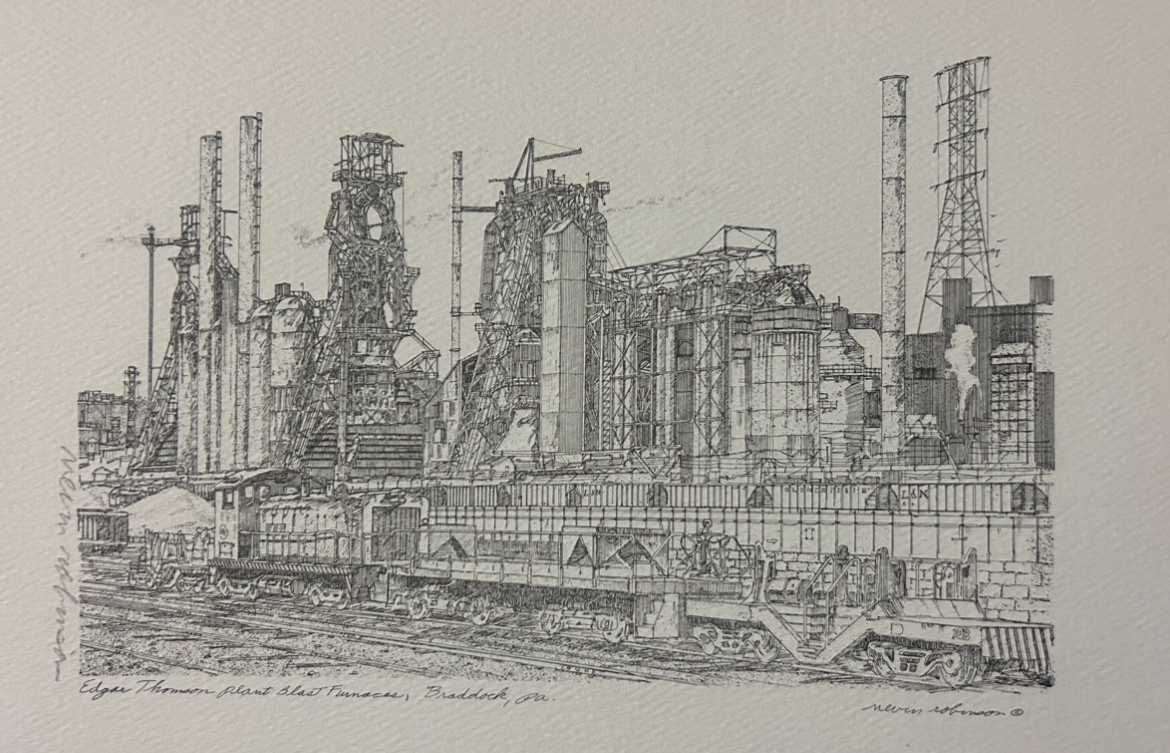
“He did all of the churches, and people would say, ‘My daughter was married there,’ or, ‘we were married there.’ He did the steel mills and we’d hear, ‘Grandpa worked there.’ He did all the colleges because most people loved where they went to school. The sports scenes did well when the teams were doing well. He drew things that people could relate to and identify with. People would say to him, ‘What’s your favorite one?’ And he always says, ‘The one that sells,’” she said.
Click here to see a variety of Robinson’s work!


Cass • Nov 17, 2025 at 7:57 am
beautiful work!! loved looking at some of his pieces!
Rylin Kinzel • Nov 17, 2025 at 7:56 am
WONDERFUL WORK, I LOVE ALLISON AND NEVIN
emilio • Nov 17, 2025 at 7:55 am
absolutely peak. this is incredible, allison.