

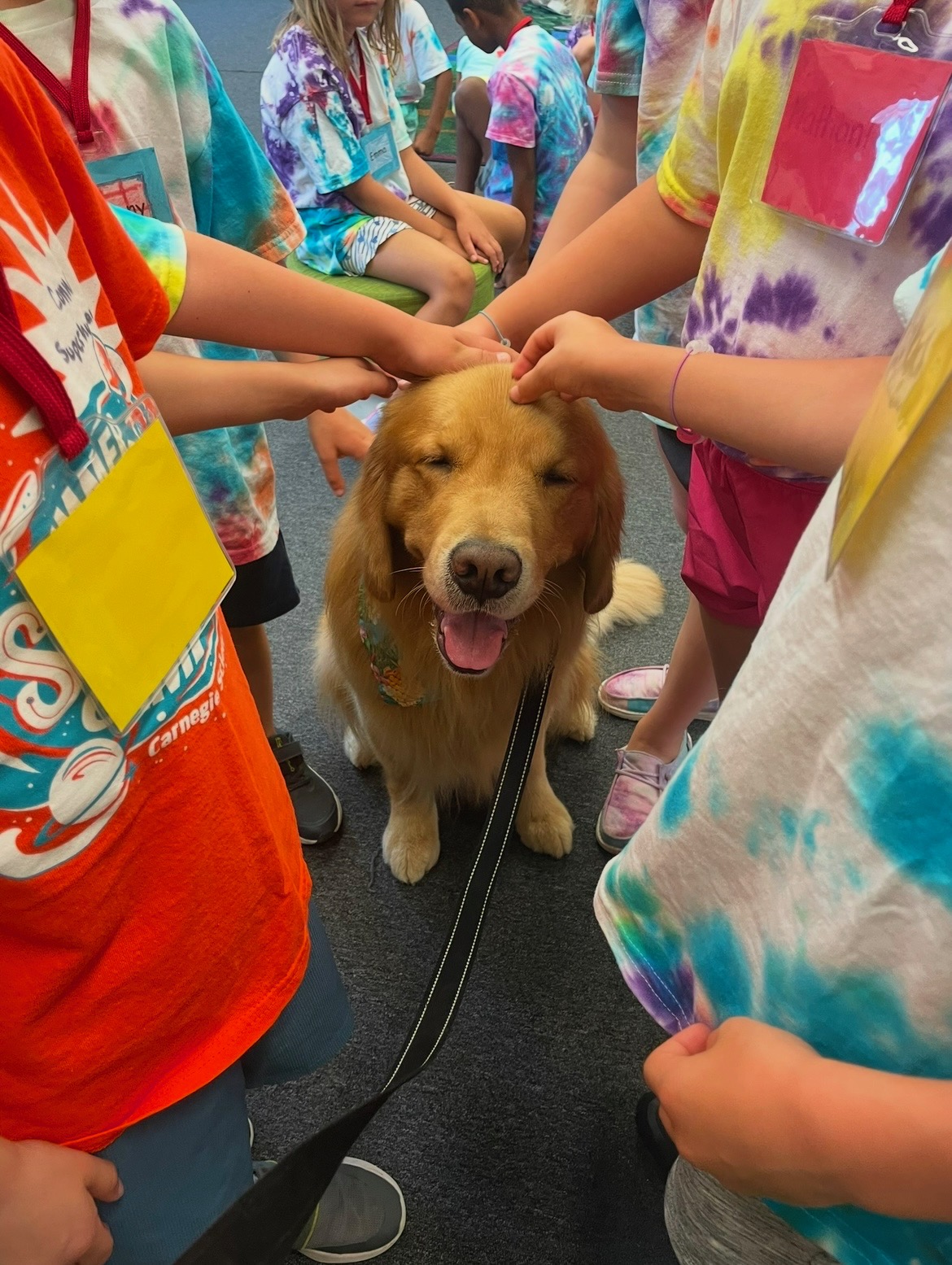
Over 15,000 years ago, humans began transitioning from hunter-gatherers and evolved a symbiotic relationship with wolves. Since the initial introduction between species, wolves have evolved into the fuzzy, fun, loving best friends many of us have today. In addition to their ability to protect, dogs possess therapeutic qualities, solidifying a bond with humans that has survived centuries. Today, we recognize the importance of these qualities, utilizing them to help people in need. In an interview with The Oracle, three therapy dog handlers share an inside perspective on the significance of their job.
Therapy dogs vary widely in terms of breed, personality and job capabilities. There is no sole ‘type’ of dog fit for therapy services. Dogs have a natural ability to detect when something is off in their environment. This is primarily through their incredible sense of smell, which allows them to detect everything from hormonal shifts inside our bodies to chemical markers such as cancer.
Meet Murphy
Mrs. Laurie Lang, a part-time groomer and therapy dog handler, has a beloved Golden Retriever named Murphy. Since his birth on June 29th, 2021, Murphy has always loved interacting with people.
“I would take him everywhere since he was eight weeks old, knowing that this is what I wanted to do. Before he was even fully vaccinated, he was in a shopping cart at Home Goods. As soon as he got fully vaccinated, he was out of the cart,” said Lang.
The training process prior to the certification test depends on the intended job the dog will carry out. For Murphy, Lang was fortunate enough to complete his training on her own.
“I did the training myself. It took about three to four months of working with him day in and day out. I went on to the website of the Alliance of Therapy Dogs to see what they had to know what to do and not do. I just kind of worked with him every day,” she said. “We went through all the aisles where the breakables were. We would go to Home Depot, and I would drop a piece of wood, hit the button on the blowups, stuff like that to train him not to be afraid. He is definitely food motivated, that makes things a lot easier.”
Therapy dogs serve a great purpose in a variety of environments. Murphy is approved to visit multiple schools and nursing homes in the Allegheny County area. Although the two types of spaces differentiate in numerous ways, Murphy’s love stays unwavering no matter who he is interacting with. Some of the places that Murphy visits include Blessed Trinity Academy, Hampton Area Middle School, Harmony at Harts Run and Grace Manor at North Park.
“It just brings joy to everybody. I think he likes the kids better than the seniors. Not that he doesn’t like them. It’s just a little more energy with them. [Blessed Trinity Academy] was our first place that we went to. We do Grace Manor Care and we do Harmony at Hearts Run. You have to reach out yourself, I just started reaching out to different places. I went in for a little interview and here we are, three years later,” Lang explained.
Being a therapy dog is not an easy-going job, despite the way it may appear to be from an outside perspective. When Murphy comes to visit, he is working, and it can take a lot of energy out of him. Lang knows this, and she prioritizes giving Murphy ample time to simply be a dog.
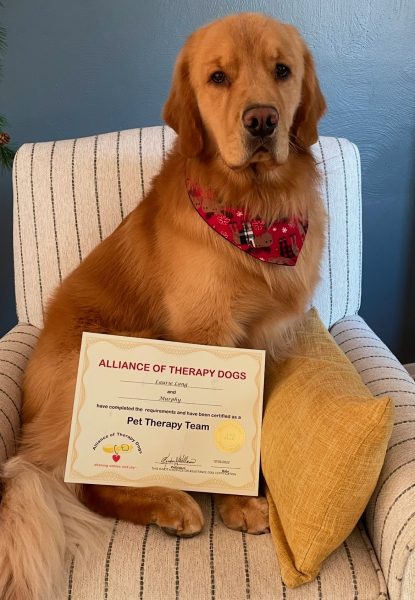
“I just don’t want Murphy to work every day, you know? They need a break. We’ll do maybe two visits all summer because I want him to be a dog. I just want him to have fun and go swimming. This time of year, of course, he loves the snow. Get him off leash and he’ll just run. In the summertime, he loves swimming in the water. We go to the beach every year for two weeks in the spring so he can enjoy himself. He even tries to catch the dolphins. The deer too, He’ll smell them and he’ll go chase him,” she said.
While most therapy dogs are provided through nonprofit services, Murphy is Lang’s own personal project. It is all volunteer work at no cost to the people interacting with him. Though initially nervous about interacting with so many people, Lang has fully eased into her job as a therapy dog handler, and finds the experience to be rewarding.
“I never thought I could do this. On our first visit, I was like, ‘oh my gosh, I can’t get up in front of people and talk.’ It’s easier with being in front of the kids talking. The questions that the kids ask, and then the games we play with the kids, it’s fun. We always do a little bit of tricks after. He doesn’t know many, but I keep saying every year I’m going to teach him a new one,” said Lang.
Meet Bridger and Zion
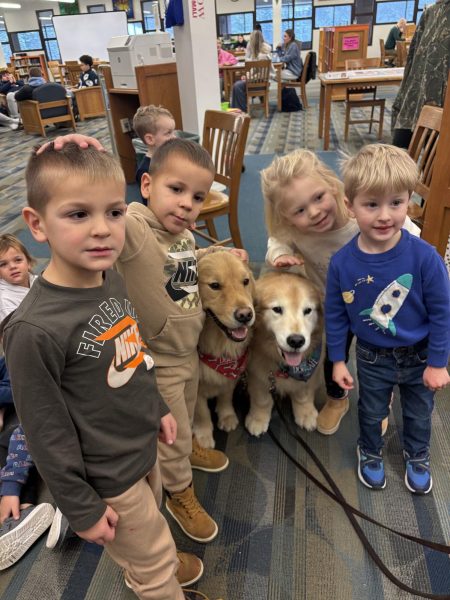
Similarly to Lang, another one of the therapy dog handlers interviewed, Mrs. Lynn Springer, also works with Golden Retrievers. Springer is the owner of two goldens, lovingly known as Bridger and Zion.
“Bridger is almost 11 years old. She is the epitome of what a therapy dog should be. She is calm, she is easygoing, she loves everybody – tolerant of virtually everything; nothing bothers her. She is a cuddler, she loves to get in bed with kids, she loves to be hugged – Contrary to people saying the dogs don’t like hugs,” said Springer, “Zion is 2 and a half years old. He’s got the same gentle temperament that Bridger has, but he still has a lot of puppy in him. He likes to jump on people, he likes to run around the house and do goofy things like steal shoes and socks and pillows. But he’s learning from his big sister to be a really, really good therapy dog.”
Springer is no stranger to working with therapy animals; prior to owning Bridger and Zion, she went through the training process with her other dog, and fell in love with the experience.
“I got involved with pet therapy with my last golden retriever, who a friend suggested to me would make a great therapy dog at Children’s Hospital. I was a little reluctant, I didn’t know if that was the kind of thing I would like to do, but she helped me train him. He trained very quickly, and was certified as a therapy dog at the age of 11 months,” she said.
The certification process for Bridger and Zion differentiated from that of Murphy, as Springer went through a specific training program to ensure her dogs were fit to visit Children’s Hospital. However, similarly to Murphy’s situation, training begins very early in the dogs’ lives.
“The training starts at seven or eight weeks of age with puppy kindergarten. Going on from that into beginning obedience, and then advanced obedience. Then they actually take specialized classes in therapy dog work. They learn to be comfortable around wheelchairs, walkers and IV poles. They have to become less sensitive to noises, so we’ll drop bowls on concrete floors and make sure they don’t get bent out of shape about that. They go out in the community and do training so that they understand, whatever they encounter, they have to be comfortable with. It’s a long process. Bridger went through training for about four years. Zion is still in training, even though he’s a certified therapy dog already,” explained Springer.
Many hospitals hold specific rules regarding what training therapy animals need to pursue, as well as the breeds and types of animals allowed to visit or work through their programs. Although there is no requirement or specific breed fit for therapy work, there are circumstances that prevent dogs from being allowed to visit hospitals.
“There are plenty of Rottweilers and Pit Bulls that are certified therapy dogs. They are not allowed at Children’s Hospital. Children’s has a policy that those two breeds aren’t allowed, and that’s mostly because kids that are in the hospital with dog bites. Those are the two breeds that they’ve usually been bitten by, and they don’t want to see that dog walk into their room. Goldens are particularly well suited for therapy because they’re just people’s lovers, and they’re very calm and gentle; but there’s all kinds of different breeds that do pet therapy,” she said.
Due to the COVID-19 outbreak during 2020, Children’s Hospital has implemented new rules regarding where in the building therapy animals are allowed and how many people they interact with. However, these requirements were not in place when Springer was working with her other dog.
“My first therapy dog went everywhere in the hospital, he would be in bed with kids that had epilepsy when they would have a seizure. We were in the ICU with him with a little boy who was on a heart and lung bypass machine. The boy didn’t know the dog was there, but the family did,” Springer recalled.
Much like Murphy, Bridger and Zion visit a variety of different environments. Their services provided as therapy animals are valued everywhere.
“Children’s is the only hospital we go to, but they also go to elementary schools. They visit regularly at St. Vincent College in Latrobe and Seton Hill College in Greensburg. We’ve been to libraries, we’ve been to police stations. Pretty much anywhere that requests a pet visit. I don’t do nursing homes; a lot of people take dogs to nursing homes, which is a great thing, that’s not my thing,” she said.
As mentioned previously, many therapy animal services are provided through specific non-profit programs; this is held true for Bridger and Zion.
“There is no cost. These guys are part of what’s called the Pet Friends program at Children’s. It is subsidized by donations to the hospital. People make donations specifically for the Pet Friends team, but there is no cost. Children just have to get the okay from their doctors, and then they get put on a list for dog visits. Really, anybody in the hospital that has the doctors okay, can interact with the dogs for no cost at all. They can also request special visits. We’ve gone down there just to visit one child that needed a dog for a particular reason. It’s the best program in the world, because it serves everybody in that hospital. Staff, patients and families,” Springer explained.
Meet Pepper
There are a wide variety of reasons someone may choose to train their pet to be certified in animal therapy. For Mrs. LeeAnn Guido, a former therapy dog handler, her situation was much different than that of Lang and Springer.
Guido is the owner of a 10-year-old Labradoodle named Pepper. Pepper is officially a senior aged dog, and retired from her job as a therapy dog last year.
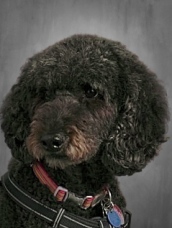
“We ended up getting Pepper because my daughter was diagnosed with diabetes. My brother had a dog who was super in tune with him and would wake up his wife whenever his sugar was really low in the middle of the night. And so, my mom convinced me to get a dog because my daughter had diabetes. I would not trade Pepper for anything. She is part of the family,” explained Guido, “I certified Pepper because my daughter wanted to do some volunteer work, but she was only 12 at the time. It’s really hard to find volunteer opportunities for 12 year olds, but she could be a therapy dog handler as long as a parent was with her at all times.”
Much like Lang and her dog Murphy, Guido trained Pepper outside of an official program. It was through day-to-day observation that they saw her natural therapeutic qualities.
“My husband did all of the training. Pepper just very clearly had a natural personality for it. We would have big summer picnics, lots of people would be there. We just noted that she was so gentle with our elderly family that was there walking with a cane or walker; she would never trip them up, she was so gentle. When the little kids were running around and pulling on her tail or whatever, she would just be so chill about it. So I just felt like it was a natural fit. It was pretty quick to just train her; our handler that trained us joked that the training is more for humans than it is for dogs. We had to go through that training of just being able to walk past other dogs and not be distracted, or be around crying babies and not react,” she said.
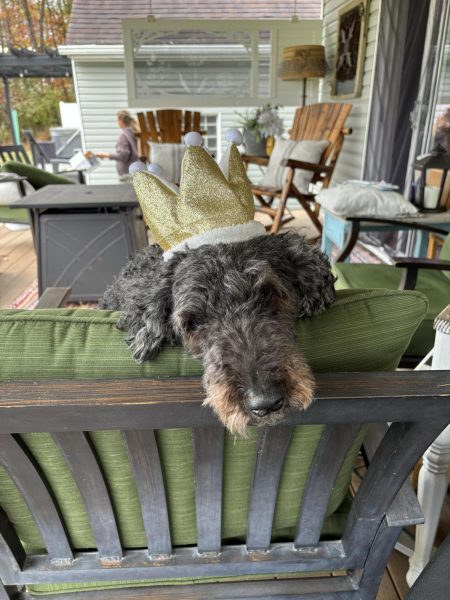
Guido works full time as a social worker at Shaler Area High School. Outside of handling Pepper with her daughter, Guido also frequently brought Pepper to the High School to offer therapeutic comfort to students in need. Working in a field that demands being present emotionally all the time takes a toll on the body; the same applies for the therapy dogs.
“There’s just a lot of life factors to take in. Personally, as a social worker, I spend my entire day being empathetic, taking care of people and being therapeutic. And so, for me, the truth of the matter is, I don’t have the energy to pour into other people in the evening. I spend my entire day pouring into people, multiple days a week. My evening hours need to be for self-care. That is important in a caring profession, you need to take care of yourself too. The dogs do as well,” Guido acknowledged.
Dogs’ have proven time and time again how they have earned the title of “Man’s Best Friend.” For some people, therapy animals have offered support and comfort in ways that cannot be recreated. Lang, Springer and Guido have each demonstrated how important it is that services such as these exist for people of all ages.


